Hand Embroidery vs. Machine Embroidery: How to Tell the Difference (and When Each Is Right)
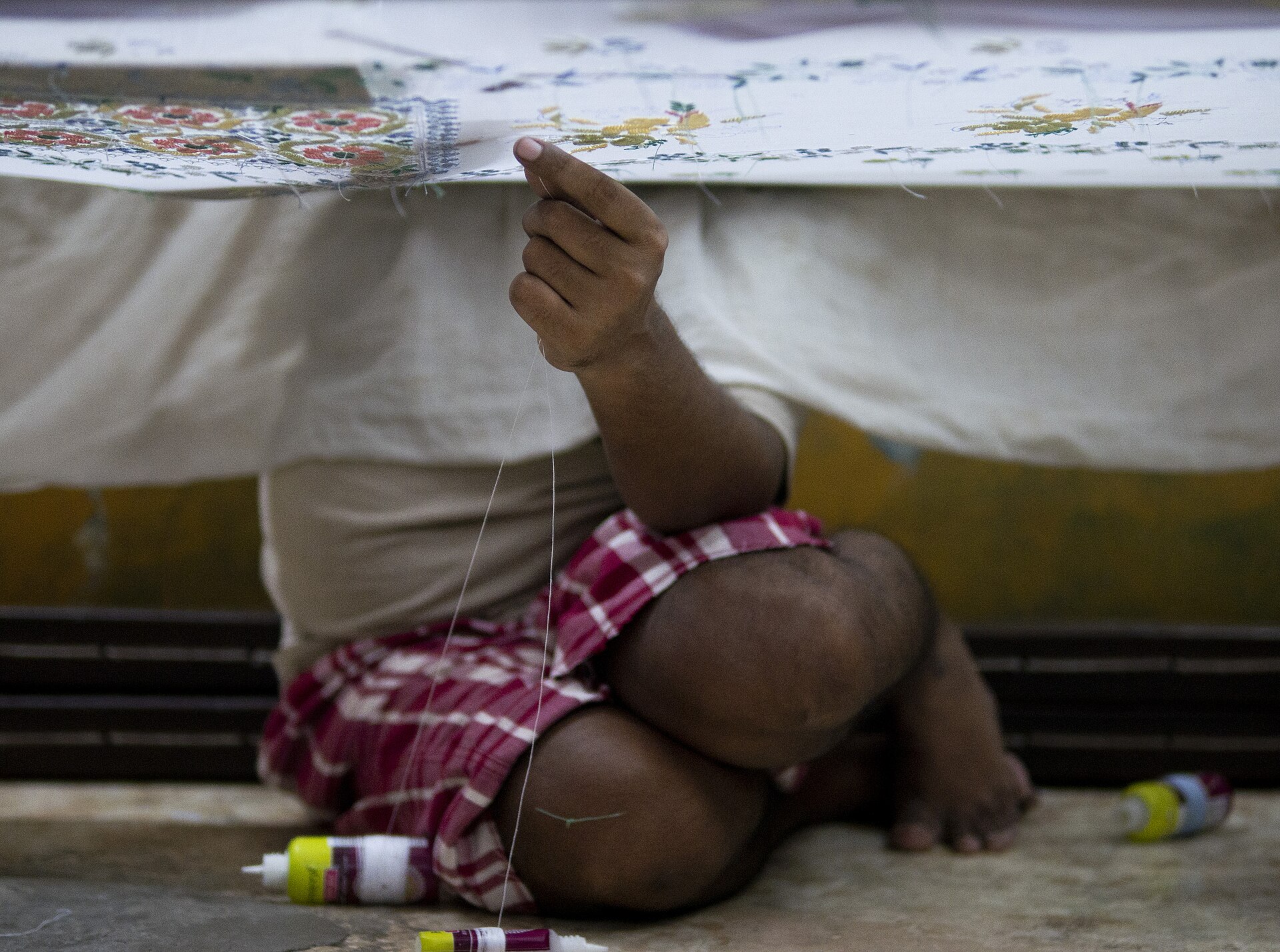
The short answer: hand embroidery is worked stitch by stitch by an artisan with a needle or hook, so it shows subtle variation, dimensional relief, and an irregular reverse side; machine embroidery is stitched by a programmed machine, so it is flat, perfectly uniform, and backed neatly. Neither is automatically better — hand work suits couture beadwork and small, expressive runs, while machine work suits precise repeats and volume.
Our Mumbai atelier has produced hand embroidery for design houses since 2000, and our team is often asked to look at a garment and say how it was made. The distinction matters commercially as well as aesthetically: it affects cost, lead time, repairability, and how a piece will photograph and feel in the hand. This guide explains the checks our team uses, and how designers can choose deliberately rather than by habit.
1. Turn it over: the reverse side tells the truth
The fastest test is the back. In hand embroidery, the reverse shows the artisan's path — small knots where a thread began or ended, threads travelling between motifs, and slight changes in tension. In tambour and aari work, the chain formation looks hand-guided, not mechanically locked. Machine embroidery, by contrast, usually presents a tidy underside: a contrasting bobbin thread, trimmed jump stitches, and often a stabiliser or backing that was needed to hold the fabric under machine tension. A very clean reverse is not a fault, but it is a strong machine signal.
2. Look for variation — or its absence
Run your eye across a repeated motif. A machine repeats it exactly: same stitch length, same angle, same spacing, motif after motif. Hand work repeats the design, not the millimetre. Two flowers will be sisters, not twins — a bead sits fractionally differently, a French knot is a touch fuller. At a distance this reads as life and light; under magnification it is unmistakable. If every sequin reflects at precisely the same angle across a whole bodice, suspect a machine or machine-assisted setting. If the light moves unevenly and richly, an artisan likely set each element by hand.
3. Feel the relief and the materials
Hand techniques such as zardozi, beadwork with cutdana, raised thread work, and 3D appliqué build genuine height that changes direction as the hand works. Materials can be mixed freely in a single motif — a stone held by thread, a bead beside a sequin beside a knot — because the artisan chooses the next element in the moment. Flat satin stitch, uniform logos, and dense thread-only repeats with no dimensional change are where machines excel. If a motif includes heavy, irregular, or fragile materials placed one by one, it almost certainly required a hand.
4. When machine embroidery is the right choice
Our team recommends machine work without hesitation in the right context: flat emblems and logos that must match exactly, large production volumes on a tight calendar, simple thread motifs repeated across many sizes, and price points where hand hours cannot be recovered. Machine sampling is also faster to revise in software. Choosing machine work for those jobs is good design management, not a compromise in integrity — provided the buyer and the maker both name it honestly.
5. When hand embroidery earns its cost
Hand work earns its place when the embroidery is the garment: heavily embellished bridal panels, couture eveningwear, dimensional florals, mixed-media beadwork, and small runs where a house wants character over uniformity. It also allows mid-course judgement — an artisan can ease density around a curve, a neckline, or a delicate base fabric in ways a programme cannot sense. That judgement is what designers are paying for, along with repairability: a hand-worked motif can usually be restored stitch by stitch. For guidance on vetting an atelier for this kind of work, see our earlier guide on how to choose a hand embroidery partner in India.
6. The hybrid approach many houses now use
Many collections combine both: a machine lays a precise ground, outline, or repeat, and artisans finish with hand-set beads, sequins, stones, or appliqué. Done well, this controls cost while keeping the visible, light-catching surface unmistakably hand-finished. Done poorly, the two layers fight — machine tension puckers the ground, or hand additions sit awkwardly on a flat base. The decision belongs at sampling, not in production: specify element by element what is hand and what is machine, approve a hybrid swatch, and keep that swatch as the standard for the run.
Frequently asked questions
What is the easiest way to tell hand embroidery from machine embroidery?
Turn the piece over. Hand work shows knots, thread travels, and slight irregularities on the reverse; machine work shows a neat bobbin thread, stabiliser backing, and perfectly uniform stitches.
Is hand embroidery always better than machine embroidery?
No. Hand is better for dimensional beadwork, couture relief, mixed materials, and small expressive runs. Machine is better for flat logos, precise repeats, large volumes, and identical placement.
Can hand and machine embroidery be combined in one garment?
Yes. A machine can lay a precise ground or repeat, and artisans then add hand-set embellishment on top. Plan the split at the sampling stage and approve a hybrid swatch.
Why does hand embroidery cost more?
Because each motif is worked stitch by stitch by a skilled artisan, often over many hours for dense panels. Cost reflects artisan time, material complexity, and checking.
Developing a collection?
Our Mumbai team is glad to share our current swatch folder — including hand, machine-comparison, and hybrid examples — and walk you through sampling for your next range.
Start a conversation with our office · More from our journal